Panel 1.11.0 Release
What is Panel?
Panel is an open-source Python library for building tools, dashboards and complex applications entirely in Python. It comes with the PyData ecosystem, advanced data tables and much more built in, and offers both high-level reactive APIs and lower-level callback-based APIs, so you can put together an exploratory app in a few lines or develop a multi-page application with rich interactivity. Panel is a member of the HoloViz ecosystem, alongside a suite of tools designed for data exploration.
New Release!
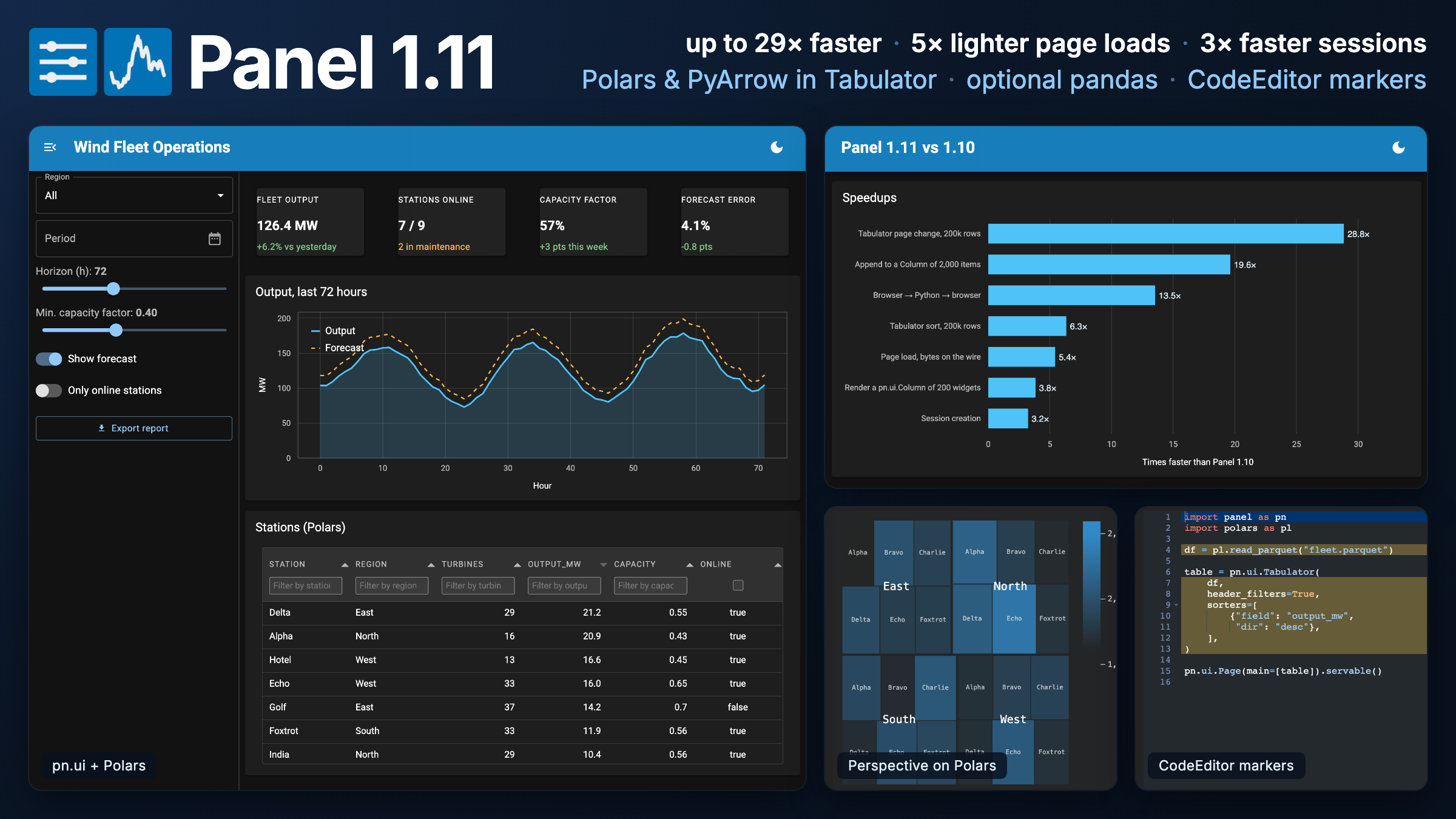
We are happy to announce the 1.11.0 release of Panel! Panel 1.10 changed how you build Panel apps with pn.ui. This release makes those apps, and the classic ones, faster. We spent a large part of the cycle profiling real applications and removing fixed costs from every page load, session, component and event. The same app, unchanged, now loads a fraction of the bytes, starts sessions faster and answers events in less than half the time, and param 2.5 and panel-material-ui 0.17, released alongside it, add to these gains. Tabulator and the other data components now also work with Polars, PyArrow and other DataFrame libraries, which let us make pandas an optional dependency, and the release fixes a long list of bugs, including several affecting authentication and apps deployed behind a reverse proxy.
Many thanks to @fizzbeom and @morgan-coded for responsibly reporting the security issues fixed in this release, and to the contributors to this release: @philippjfr, @hoxbro, @maximlt, @aarab-malik, @AaryanRS, @benjibunbun, @Cherith1222, @chiruu12, @Jojoussef, @SAMARTHJAISWAL, @Web4everyone32, @YashAnand69, @Adithya6721, @Adititodekar, @ahuang11, @Alpenj, @compiler-segfault, @danishkumar26, @JoeyTan21, @Kkkakania, @MarcSkovMadsen, @mmporong, @mvanhorn, @nightcityblade, @nojaf, @prabhushreyas, @ryandesign, @SuMayaBee, @sushan5140 and @tmichela.
If you’re using Anaconda, you can install the latest version of Panel with conda install panel. If you prefer pip, use pip install panel. Note that pip no longer installs pandas for you; use pip install "panel[recommended]" if you want it. To also get the new param and panel-material-ui releases, upgrade them together, e.g. pip install -U panel param panel-material-ui.
Performance
Panel 1.11 removes a lot of fixed cost from serving an app: in the bytes a page loads, in the work done for each session and component, and in the overhead around each event. You get all of it without changing any code.
To see what that means for a real app, we built the same dashboard twice, once from classic components in a FastListTemplate and once from Material components in a pn.ui.Page. Each has around 180 components: 40 widgets in the sidebar, a row of indicators, a Bokeh plot, a 1,000 row Tabulator, some Markdown and a card with 120 more widgets. We served both with Panel 1.10.1 and 1.11.0 and measured them in headless Chromium, alongside a few Python-side scenarios around large layouts and tables. Panel 1.11 works with param 2.4 and panel-material-ui 0.16 as well as with the new param 2.5 and panel-material-ui 0.17, so the chart shows it with both. The measured times for every scenario are in the appendix.
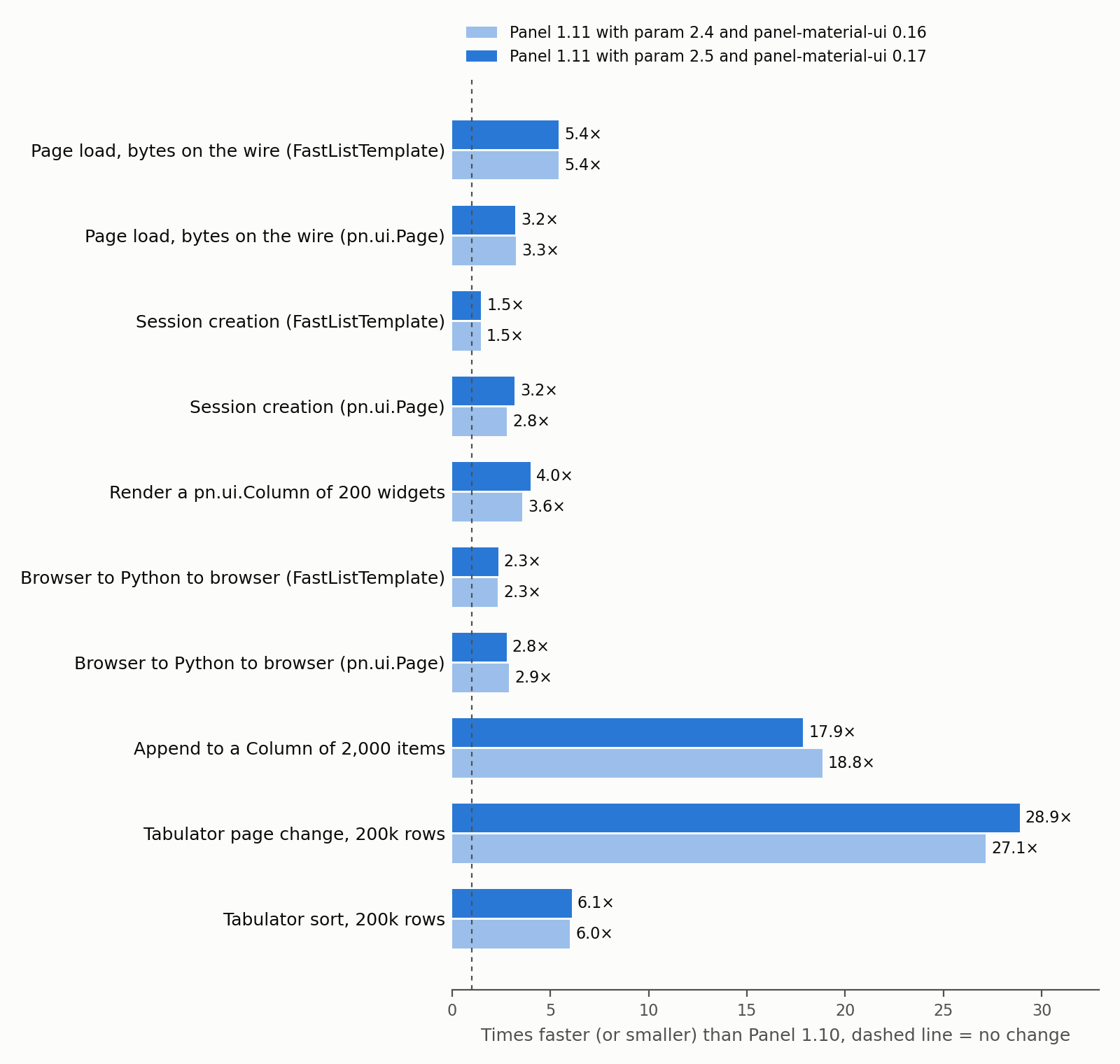
The biggest change on page load is the amount of data. MathJax used to be loaded by every template page and is now only loaded when a page contains math, templates no longer load their resources twice, and responses are gzipped (#9058). Our benchmark runs on localhost, so it barely shows in the load time, but over a real network the drop from 5.5 MB to 1 MB matters much more. Versioned resources also get long-lived cache headers, so the browser reuses them without asking the server again.
Creating a session is where every user waits before seeing anything, and it also limits how many users a single server process can handle. Caching the per-request resource bookkeeping (#9068), cheaper Bokeh model creation (#9064) and cheaper component construction (#9069) speed up every app. Material components benefit most, because JSComponent and ReactComponent now compute their per-class information once instead of for every instance and skip properties that are still at their defaults (#9067, #9095). That roughly triples how many Material sessions a server can create per second.
The round trip measures how long it takes from a change in the browser until the update made by a Python callback arrives back. On a fresh server it went from 54 ms to 23 ms on the classic page and from 67 ms to 23 ms on the Material page. 1.10 also got slower the longer a server ran: after the session benchmark had loaded the page 63 times without opening a websocket, as health checks and abandoned page loads do, every event on the Material page took more than 400 ms, while 1.11 stays at 23 ms. Busy-state bookkeeping and in-place pane updates got much cheaper, a widget value change no longer unlocks and relocks every parameter of the widget (#9158), and Panel now waits 20 ms instead of 50 ms for further changes before processing an event from the browser (#9066). Appending to or replacing children of a large layout, which chat apps and logs do all the time, no longer scales with the number of children already there (#9057, #9160, #9162), and Tabulator updates on large tables no longer reprocess or resend the whole table (#9071). In the browser, Tabulator now applies stream, patch and selection changes to the existing table instead of rebuilding it (#9065).
A few other improvements are not in the benchmarks: pn.cache hits are more than ten times cheaper (#9063), Vega and Plotly panes avoid redundant re-renders (#9061), and Documents cleaned up without a session, such as those created by health checks, no longer stay in memory forever (#9059).
All numbers are medians over 5 runs of the served benchmarks (each on a fresh server, with the 40 round trips in each run also reduced to their median) and 7 runs of the Python-side ones. We ran them on an Apple M5 Pro with Python 3.14.4 and Bokeh 3.10.2, comparing Panel 1.10.1 with param 2.4.2 and panel-material-ui 0.16.7 against Panel 1.11.0, once with the same param and panel-material-ui and once with param 2.5 and panel-material-ui 0.17, measured with param 2.5.0rc0 and panel-material-ui 0.17.0rc4. The page loads and fresh-server round trips come from a separate run, without the session benchmark beforehand, with panel-material-ui built from its main branch shortly before the release, which includes the MUI 9.6 update. The scripts are in the benchmarks folder next to this post if you want to reproduce them.
param 2.5 and panel-material-ui 0.17
We are releasing param 2.5 and panel-material-ui 0.17 alongside Panel 1.11, and both add to these gains. You get everything above with the param and panel-material-ui you already have installed, and more once you upgrade them.
param 2.5.0, the library underneath every Panel component, makes the hot paths of parameters cheaper. Reading a Number parameter is about 2.4× faster and setting one that triggers watchers about 2.2× faster (param#1167), and old and new values are compared once per event instead of once per watcher (param#1234). Every widget value, layout change and pane update goes through these paths, so the whole of Panel benefits. The release also adds param.Model, which builds parameters from type annotations, and a DataFrameLike parameter for any DataFrame supported by Narwhals.
panel-material-ui 0.17.0 focuses on what Material components cost under load:
- Streaming into
ChatMessageandChatFeedno longer re-syncs the whole page on every token. Streaming 500 tokens into the last message of a 500 message feed went from about 20 s to 0.2 s. - Widgets are constructed up to twice as fast, and setting
TextInput.valueon a rendered widget is twice as fast. Select,MultiChoice,CrossSelectorandAutocompleteInputprocess their options in linear time, so re-rendering aSelectwith 50,000 options went from about 2.7 s to 30 ms.- Switching the active tab of a dynamic
TabsorAccordionis four to five times faster, and switching dark mode takes a single message instead of a round trip per component. Pageand the notification area no longer leak, which also made every callback slower the more pages had been created.
In our benchmarks the two releases together bring Material session creation from 127 ms to 112 ms, raise the number of Material sessions a server creates per second from 7.6 to 8.3, cut rendering a pn.ui.Column of 200 widgets from 106 ms to 94 ms and the first Material page load from 834 ms to 707 ms. Classic apps change little, as you would expect.
Any DataFrame, and optional pandas
Panel 1.10 taught the DataFrame pane to render any DataFrame supported by Narwhals. In 1.11 the interactive data components follow: Tabulator, the DataFrame widget, Perspective and Vizzu accept Polars, PyArrow and any other eager DataFrame Narwhals supports, without converting it to pandas (#8841). Filtering, sorting, remote pagination, selection, edits, stream() and patch() all work, and .value stays the type you passed in:
import panel as pn
import polars as pl

df = pl.DataFrame({
    'station': ['Alpha', 'Bravo', 'Charlie', 'Delta', 'Echo', 'Foxtrot'],
    'region': ['North', 'South', 'North', 'East', 'West', 'South'],
    'output_mw': [12.4, 8.1, 15.0, 9.7, 11.2, 6.3],
    'online': [True, True, False, True, True, False],
})

table = pn.ui.Tabulator(
    df,
    header_filters=True,
    sorters=[{'field': 'output_mw', 'dir': 'desc'}],
    layout='fit_columns',
    sizing_mode='stretch_width',
)

total = pn.ui.Typography(variant='h6')

def update_total(event=None):
    total.object = f"Total output: {table.value['output_mw'].sum():.1f} MW ({type(table.value).__module__.split('.')[0]})"

table.on_edit(update_total)
update_total()

pn.ui.Page(title='Polars in Tabulator', main=[total, table]).servable()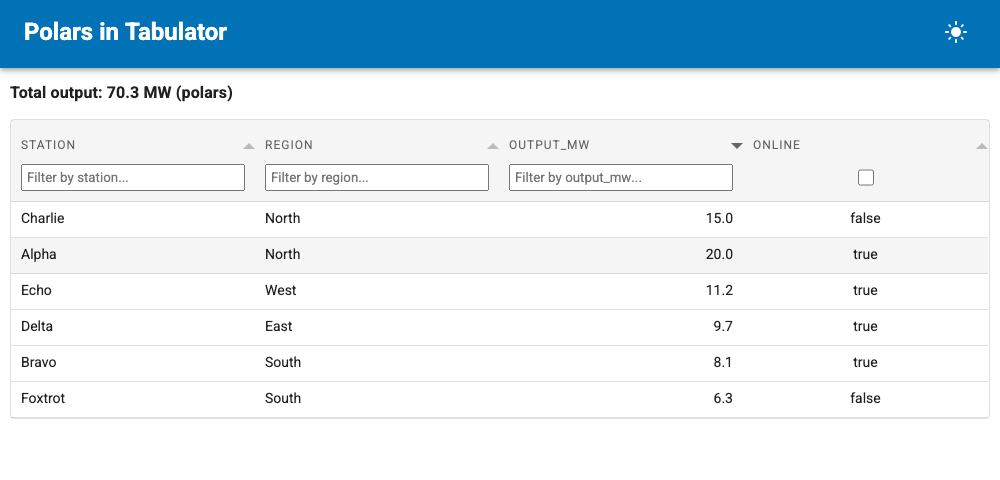
After editing Alpha’s output to 20, the total is recomputed from the Polars frame.
Since these frames have no index, rows are addressed by position, and Styler based styling remains pandas-only; the Tabulator reference has the details. With nothing in Panel’s core depending on pandas any more, it has moved to the recommended extra, as announced in the 1.9 release notes. If your app uses pandas, make sure it is in your own requirements.
Bug fixes
This release contains around a hundred bug fixes. Two groups deserve a mention because they affect how apps are deployed.
Authentication got several fixes. The login redirect validation now rejects next values such as ///evil.com, which browsers resolve to another site, closing an open redirect in both the basic auth and OAuth login flows (#8938); we recommend upgrading if you use authentication. 1.11 also includes the two security fixes released in 1.10.1 and 1.9.5: the server no longer imports the module named in a /components/ resource URL, which let any client stop the server with a single request (GHSA-wfhv-r23p-8x9w), and authorize_callback now also applies to autoload.js and websocket connections, so a user denied access to an app can no longer open a session of it (GHSA-9cgh-cwhr-4rhg). OAuth behind a reverse proxy or with --prefix used to need a hand-written --oauth-redirect-uri, and some setups did not work at all. Panel now derives the external URL from the request, --root-path, --prefix and, with --use-xheaders, the X-Forwarded-Host and X-Forwarded-Prefix headers, and uses it for the redirect URI and every login and logout redirect (#9072, building on #8211 by @TheoMathurin). --oauth-guest-endpoints entries ending in /* now cover the paths below them, so a branded login page can load its assets (#9033), and Panel warns when the session token gets close to the 8 KB header limit of common proxies, which otherwise surfaced only as “Could not open websocket” in the browser (#8638).
Resource loading behind proxies and on nested routes is also fixed. Stylesheets defined relative to a design or theme were cached with the URL of whichever route rendered them first, so a page on a nested route such as /dash/<id> requested them from the wrong place and got a 404. Lazily loaded resources had the same problem after navigating within an app under panel serve. Both now resolve against the route the session is on, including behind a proxy that strips its prefix (#9109). Hosts that rewrite or do not serve Panel’s static/extensions/ routes, such as Shiny, now load components too, falling back to the CDN when a resource request fails (#9020).
Beyond those, threaded apps no longer hit races on the document lock, updates made inside a long running synchronous callback reach the browser while it runs again, notebooks sync every change of a message, and Tabulator, Plotly, FloatPanel, Tabs and the classic templates received many smaller fixes. The changelog below has the full list.
Upgrading
A few changes may need your attention. pip install panel no longer installs pandas. The default OAuth redirect URI now includes --prefix and follows the forwarded headers with --use-xheaders, so you may have to register the new URI with your provider or pass the old one with --oauth-redirect-uri. Responses are now gzipped (turn it off with pn.serve(..., compress=False) if your proxy already compresses), and changes from the browser are debounced for 20 ms instead of 50 ms. The upgrade guide and the behaviour change markers in the changelog cover the rest.
Panel and AI
The chat components benefit from the performance work, and streaming text with math into a Markdown pane now typesets only the blocks that changed (#9061). ChatInterface gained a widget_placeholder parameter (#9040). If you use an AI coding assistant to write Panel code, point it at our llms.txt, which indexes Markdown versions of every documentation page, or install the HoloViz Agent Skills with uvx holoviz-skills@latest install. The guide on using Panel with an AI assistant covers both.
What comes next
We now have benchmarks for page loads, sessions, components, layouts, Tabulator and caching, so we can keep measuring as we go, and we will keep chipping away at the remaining costs. Panel 2.0, where the Material components become the default, stays the larger goal. If you have questions or want to share what you built, join us on Discourse or Discord, and please report bugs and ideas on GitHub.
Changelog
For the full list of changes, see the Panel 1.11.0 changelog.
🚀 Features
- Accept Polars, PyArrow and any other eager DataFrame supported by Narwhals in
Tabulator, theDataFramewidget,PerspectiveandVizzuwithout converting it to pandas. Filtering, sorting, remote pagination, selection, edits,stream()andpatch()all work on these frames, with rows addressed by position since they have no index, and PyArrow tables keeplarge_stringand other large column types when they are edited, patched or streamed into (#8841, #9086)
✨ Enhancements
- Accept positional arguments to the cached function in
pn.state.as_cached(#9123) - Show a default
Filter by <column>...placeholder inTabulatorheader filters (#8452) - Add a
widget_placeholderparameter toChatInterfacethat sets, and later updates, the placeholder of its default input widget (#9040) - Add
max_completionstoAutocompleteInputto limit the number of suggestions shown (#9031) - Let
saveexport PNGs with Bokeh’s Playwright backend, selected with the newbackendargument (e.g..save('x.png', backend='playwright')) orBOKEH_EXPORT_BACKEND, and apply Panel’s page template and idle wait to screenshots again on Bokeh 3.10 (#8918) - Add a
compressoption topn.serveandget_server(defaultTrue) to turn off response compression, for example behind a proxy that already compresses (#9058) - Let
--oauth-guest-endpointsentries ending in/*or/cover the paths below them, so e.g. a branded login page can load its logo from--static-dirs; plain entries now match the path without the query string but still do not cover sub-paths (#9033) - Log a one-time warning per app when the Bokeh session token approaches the 8 KB request header limit of common proxies, which otherwise fails with an unexplained “Could not open websocket” (#8638)
- Load the
TextEditor(Quill) resources from the CDN configured withPANEL_NPM_CDNinstead of always from jsDelivr (#7826) - Add
keyboard_accessibleandsoft_wrapparameters toCodeEditor, so keyboard users can move focus out of the editor and long lines can wrap (#9120) - Add a
markersparameter toCodeEditorto highlight lines, and style its read-only tooltip (#9139)
⚡ Performance
This release removes much of the fixed cost of serving a Panel app, from the bytes a page loads to the work done per session, per component and per event. The numbers below are the ones measured in each pull request.
- Load fewer resources per page and serve them compressed and cached. MathJax is only loaded on pages that contain math, template resources are no longer loaded twice, responses are gzipped, static files are compressed once and versioned resources get long-lived cache headers. A
FastListTemplatepage went from 5831 KB to 3143 KB of local resources, 830 KB on the wire (#9058) - Cache the per-request resource bookkeeping, apply a template’s design once and stop streaming log records into the admin dashboard when nobody is looking; generating the page for a 200-widget app went from 16.1 ms to 1.3 ms (#9068)
- Speed up Bokeh model creation in
server_doc; aColumnof 200 widgets went from 173 ms to 104 ms (#9064) - Cut the cost of constructing Panel components and of
pn.paneldispatch; aColumnof 20 sliders is 47% cheaper to create andpn.panel('text')42% cheaper (#9069) - Make
JSComponentandReactComponent, and with them everypanel-material-uicomponent, cheap to render and update;server_docof aui.Columnof 200 widgets went from 534 ms to 335 ms and appending to aui.Column(2000)from 167 ms to 13.7 ms (#9067, #9099) - Further reduce the cost of creating
ReactiveESMmodels, such as those ofpanel-material-uicomponents, by dropping default-valued properties when constructing the model and its DataModel, narrowing the reference scan of DataModel properties, registering event callbacks without a per-callback signature inspection and reusing the Document’s shared stylesheets instead of building a throwaway per component;server_docof aui.Columnof 200 components went from 124 ms to 86 ms with an unchanged serialized Document (#9095) - Send a compiled inline ESM bundle once per document instead of once per component, so ten
panel-material-uibuttons in a notebook or exported HTML file go from 15 MB to 1.7 MB (#9104) - Make mutations of large layouts cheap; appending to a
Columnwith 2000 children went from 89.1 ms to 10.9 ms (#9057) - Share the loading indicator CSS across all models on a Document instead of sending a copy per model, shrinking the initial document of a
Columnof 200 widgets from 126.7 KB to 74.5 KB (-41%) (#9056) - Behaviour change: Cut the per-event overhead in the server and notebook update paths and lower the default debounce of frontend changes from 50 ms to 20 ms; the browser to Python to browser round trip on the benchmark app dropped from a median of ~64 ms to ~34 ms.
pn.reactive.Syncable._debouncecan still be raised globally or per component (#9066) - Batch model updates scheduled from worker threads into one message and combine held events in linear time; a 1 ms periodic callback with
PANEL_NUM_THREADS=4went from 299–390 to 603–682 ticks/s, and settingTextInput.valuesends one message instead of two (#9070) - Process events that arrive while changes are still pending on a worker thread with the document lock, so a synchronous callback no longer blocks the event loop and its updates reach the browser while it runs (#9075)
- Avoid redundant work on
Vega,HTML,MarkdownandPlotlypane updates: Vega data updates no longer re-embed the chart (mean latency 46.5 ms -> 22 ms), streaming 200 chunks containing math intoMarkdownwent from 3665 ms to 465 ms of JS time, and a Plotly layout change made in the browser from 269 ms to 6 ms (#9061) - Update
Tabulatorincrementally in the browser onstream,patchand selection instead of rebuilding the table; a one-cellpatchon 10k rows went from 15.3 ms to 0.4 ms of JS handler time (#9065) - Cut the Python-side cost of
Tabulatorupdates on large tables; on 200k rows a remote pagination page change went from 13.9 ms to 1.2 ms and a one-cellpatch()with a sorter active from 27.6 ms and a 6.3 MB message to 2.1 ms and a 1 KB message. Also fixespatch()with remote pagination (#9071) - Stop rebuilding every
Tabulatorcolumn on each edit when column names are not strings (e.g. years after a pivot), which also closed the editor when tabbing to the next cell (#9054) - Behaviour change: Reduce
pn.cacheper-call overhead (a hit onf(1)went from 22.5 µs to 1.4 µs), give decorations with different settings separate caches and let an exact type inhash_funcstake precedence over the defaults. Hashes of flat containers change, so existingto_disk=Truecaches are recomputed once (#9063) - Release Documents cleaned up without a session (liveness checks, warm-up, the ASGI server) and cut references from models to their Document when it is destroyed, so they no longer stay alive forever (#9059)
- Only unlock the parameters that are actually readonly or constant when syncing a widget value, instead of toggling every parameter of the widget; setting a value from Python is 2.9× faster for a classic
IntSliderand 1.7× forpn.ui.IntSlider, and a value change from the browser about 1.9× faster. Also stops a constant parameter from staying writable on an instance after it was set insideedit_readonly(#9158) - Read the sizing properties of a layout’s children without Bokeh’s theme lookup, making the sizing inference on each layout change about 2.7× cheaper (#9160)
- Skip the full-tree preprocessing walks on layout changes that do not add the components they handle (HoloViews, ECharts, param methods); appending to a
Columnof 500 items is 13 to 14% faster (#9162)
🔒 Security
- Reject
next_urlvalues such as///evil.comor ones containing control characters, which browsers resolve to another site, in the basic auth and OAuth login redirects (#8938) - Stop importing the module named in
/components/resource URLs, which let any client, including when authentication is enabled, make the server import installed modules and shut it down with a single request (GHSA-wfhv-r23p-8x9w) - Apply
authorize_callbacktoautoload.jsand websocket connections, which previously let a logged-in user open a session of an app they were denied access to (GHSA-9cgh-cwhr-4rhg, #9152) - Stop
FileSelectorfrom navigating into sibling directories whose name starts with the name ofroot_directory, such as/app/data2for a root of/app/data(#9149)
🐛 Bug Fixes
- Send updates made inside a long running synchronous callback to the browser while it runs instead of only once it returns, so e.g. a loading spinner toggled in the callback shows again, on Tornado as well as the ASGI servers (#8937, #9082)
- Only treat the document lock as held by the thread that acquired it, fixing
RuntimeError: _pending_writes should be non-Noneand concurrent document writes in threaded apps (--num-threads), including on free-threaded Python 3.14, and only let the lock owner write updates directly from a worker thread (#9008, #9009, #9024) - Keep a script that ends right after
pn.serve(..., threaded=True)serving, which since 1.10.0 answered every request with a 500 error (#9073) - Fix several timing issues: Plotly clicks and hovers right after render being dropped, quick
Tabsswitches leaving broken views, timers scheduled from worker threads firing late, aTabulatorscroll right after render being reset,PeriodicCallback.start()busy looping, and threaded servers leaking sockets on Windows (#8869) - Sync every property change of a message sent from the browser in notebooks, where only the first one reached Python, so e.g.
pn.state.browser_infoandFileInputfilenameandmime_typeare populated (#9045) - Stop notebooks from echoing changes made in Python back to Python, which caused
BokehUserWarning: reference already knownwarnings (#9055) - Stop sending a change made in the browser back to that browser when it arrives while the Document is held, e.g. by a callback running on a worker thread, which on high-latency deployments reset text inputs to stale text and lost the characters typed since (#9101)
- Write changes from unlocked callbacks, such as an async task streaming into a chat message, after the changes of a callback holding the document lock when they refer to models that callback has not sent yet, instead of writing them first so the browser dropped them with
reference ... isn't known; unrelated changes are still written immediately (#9105, #9107) - Write the changes of a locked callback that are handed to Bokeh, e.g. when a
hold()block exits while the socket is busy, as one message instead of one per change, so the browser no longer renders them in steps (#9106) - Keep every view of a notebook output responsive when the output is shown more than once, e.g. with JupyterLab’s “Create New View for Cell Output” (#9062)
- Fix
MultipleInstanceErrorfromKernel.instance()(e.g. in ipyleaflet) after loading theipywidgetsextension, while still resolving the per-session kernel when serving ipywidgets from a notebook or the Jupyter preview, and render the first ipywidget of a served app reliably (#8949, #9025, #9074) - Behaviour change: Make OAuth and login redirects work behind a reverse proxy or with
--prefixwithout--oauth-redirect-uri, honouringX-Forwarded-HostandX-Forwarded-Prefixwith--use-xheaders. The default OAuth redirect URI now includes--prefixand follows those headers, so re-register it with your provider or pass--oauth-redirect-uri(#9072, building on #8211 by @TheoMathurin) - Behaviour change: Leave hierarchical
Tabulatorgroup rows blank for index levels without an aggregator instead of summing every column (and concatenating strings). Passaggregatorsexplicitly, e.g.aggregators={'grp': 'sum'}, to keep the previous sums (#9004, #9011) - Fix
Tabulator.streamon a table whose index is aDatetimeIndexor another non-numeric index, preserving the streamed index labels so repeated streams and subsequent patches work (#8858, #9023) - Convert
datetime,pd.Timestampandnp.datetime64values inTabulator.patch, which previously raised or wrote the wrong value (#9000) - Support clearing a cell in a nullable integer (
Int64)Tabulatorcolumn, which now stores<NA>and keeps the dtype (#8994) - Re-fit
Tabulatorcolumns with afit_datalayout after a cell edit or a newvalue, so longer content no longer clips; columns the user resized keep their width (#8968) - Let a
Tabulatordate header filter withfunc='like'match the timestamp text instead of raising, with remote pagination and incurrent_view(#8857) - Apply
Tabulator.stylecell styles to the right column whengroupsare set (#8966) - Behaviour change: Ignore the
widththat a pandasStyler(e.g.Styler.bar) sets onTabulatorcells, which made the column wider than its header; useTabulator.widthsto size columns (#8988) - Stop highlighting rows on hover when
Tabulatorhasselectable=False(#8955) - Support
Tabulator.jscallback(selection=...)and raise a clear error when ajscallbacktargets a parameter that only exists in Python (#8953) - Stop a
Tabulatorin an inactive tab from keeping the browser’s main thread busy (#8936) - Fix
Perspective.stream()duplicating rows in the browser, make dict patches toPerspectiveupdate.object, and stop truncating edited Polars string values (#8841) - Keep datetime axes of a
Plotlypane as dates afterupdate_tracesorbatch_update(#8952) - Fix the serialization error that dropped
Plotlyupdates made insidefig.batch_update()(#8943) - Include multicategory
xvalues and heatmap and imagepointNumber/pointIndexinPlotlyclick, hover and selection data (#8954) - Play animated
Plotlyfigures by keeping their frames, also when the figure is given as a dict (#9043) - Behaviour change: Render
MatplotlibPNGs at twice thedpiwhenhigh_dpi=True(the default), as before Panel 1.0, so they are sharp on high-DPI screens at the same displayed size; PNGs are about 2-3x larger andhigh_dpi=Falserestores the previous output (#9047) - Render Matplotlib plots in a
HoloViewspane, e.g. of aHoloMaporDynamicMap, at the DPI of the HoloViews renderer, so they are no longer twice the size of the same plot rendered by HoloViews directly (#9049) - Behaviour change: Apply the
themeof aBokehpane in served apps, notebooks and saved files by setting it on the document, asHoloViews.themedoes, so it now applies to the whole document (#8996) - Style
Segmentglyphs, such as box plot whiskers, in the dark Bokeh themes so they are visible (#8980) - Load the full KaTeX stylesheet and bundle its fonts for the
LaTeXpane, so constructs such as\hlinerender correctly (#8965) - Stop the
Markdownpane from parsing*inside$$...$$math as emphasis, including while streaming (#8970, #9014) - Stop an
HTMLorMarkdownpane from throwing when its visibility changes before it is rendered, e.g. inside a collapsedpanel-material-uiCard(#9051) - Support Altair’s
vegafusiondata transformer in theVegapane (#8939) - Render local PDF data in the
PDFpane withembed=Falsein Chromium (#8995) - Keep the per-row structure of nested columns, such as
PathLayerpaths, inDeckGLdata (#8982) - Generate Material UI widgets in
pn.ui.HoloViews, and design-specific widgets inpn.pane.HoloViews, as intended (#8976) - Keep one
HoloViewsslider option perHoloMapkey when formatted labels collide, so every frame can be selected (#8984) - Accept
pn.uilayouts forHoloViews.widget_layoutandChatReactionIcons.default_layout(#8932) - Allow non-string values in
AutocompleteInputwithrestrict=False(#8909) - Allow setting the
valueofTextInput,TextAreaInputandPasswordInputtoNone(#8917) - Show the default colour (
#000000) when thevalueof aColorPickeris set toNone, instead of raising a validation error (#9098) - Allow
fixed_startorfixed_endto beNoneon editable sliders, e.g. when generated bypn.Paramfor a parameter with one open bound, instead of raising aTypeError(#9103) - Select the right option in a
Selectwithgroupswhen the same label appears in several groups (#8956) - Select the right option when a
Selectsynced to the URL has numeric-looking options such as'02'(#8960) - Fix validation of
DatetimeInputwhen onlystartorendis set (#8910) - Show a rounded value (e.g.
0.1instead of0.10000000001) in theEditableFloatSlidertextbox when noformatis given, and apply laterformatandstepchanges to it (#8990) - Behaviour change: Round
interactslider defaults that fall between steps to the nearest step instead of flooring them, so(0, 4, 0.5, 1.3)now starts at1.5(#8947, #9013) - Render a
Nonevalue inLinearGaugelikenaninstead of raising aTypeError(#9039) - Size the animated stripes of an active
Progressbar to its height (#8981) - Respect
max_widthandmax_heightwhen sizing theDial(#8958) - Accept any
os.PathLike, such as anos.DirEntryfromos.scandir, as thefileof aFileDownload(#9090) - Render bounded
param.DateRangeandparam.CalendarDateRangeparameters without a default inParaminstead of failing to load the page (#8859) - Use an input widget for bounded
param.Numberandparam.Integerparameters whose value isNone, which previously failed to render (#8983) - Fix updating the
objectsof aparam.SelectorholdingParameterizedinstances inParam(#8985) - Behaviour change:
Widget.from_paramno longer wraps selectors ofParameterizedobjects in aRowwith an expand toggle; passexpand_button=Trueto opt back in (#8991) - Hide a single unpacked
Paramwidget when its parameter’sprecedencedrops below the display threshold (#8992) - Update the tab title when a
Tabsentry is renamed but keeps the same pane (#8944) - Support param references for
objectsinTabs,AccordionandFloatPanel(#8997) - Retain parameters such as
closableandtabs_locationwhen cloningTabsandAccordion, clampingactiveto the new objects (#8999, #9012) - Fix
clonefor components whose read-only parameters were edited withparam.edit_constant(#8948) - Size a
FloatPanelwithcontained=Falseto its content, while respecting a height set throughconfig={'panelSize': ...}(#8987, #9015) - Make
FloatPanelchildren with stretching sizing modes fill the panel height (#9001) - Let a
pn.ui.Modalgrow to fit wide content and apply an explicitwidthto the dialog (#9030) - Let
VSpacerfill the sidebar height in the Fast, Vanilla, React and Bootstrap templates (#8971) - Paint plots placed in the modal of the Fast templates in Chromium (#8972)
- Size
scale_bothandscale_heightcontent, such as responsive HoloViews plots with anaspect, in the Fast template (#8993) - Use the accent colour for the active Bokeh toolbar tool in the Fast templates (#9002)
- Show the slides when
SlidesTemplatehasmain_max_widthset (#8978) - Show the configured disconnect and ready notifications for templates built outside a session, e.g. before
template.show()(#8942) - Behaviour change: Fix
ReactiveHTMLcomponents with'literal'children failing to render the page, and render literal children as (sanitized) HTML markup rather than only their text content (#8989) - Detect
++and--assignments todata.*inReactiveHTMLscripts and no longer mistake comparisons for assignments (#8998) - Report the correct
event.nodeforReactiveHTMLcallbacks shared between several nodes (#8962) - Stop a child from disappearing from
pn.uilayouts when children are swapped inReactComponent(#8935) - Behaviour change: Stop
model.useStateinReactComponentfrom writing a stale value back over a newer model change, which could e.g. leave a widget stuck loading afterloading = Truefollowed byloading = False.setValuenow writes to the model synchronously, so a value set through it reaches the server before asend_msgsent in the same handler (#9100) - Set up
jslinkandjscallbacklinks on children added to aJSComponentorReactComponentlayout, e.g. withpn.ui.Column.extend(#9028) - Fix
JSComponentandReactComponentviews that are re-rendered or removed before they mount, which could abort the layout of the whole page (e.g. withCannot read properties of undefined (reading 'top_panel')for a Bokeh figure) or leave every component rendered afterwards blank (#9081) - Warn instead of raising when
.controls()cannot link a parameter to a missing model property (#8979) - Behaviour change: Keep the loading indicator of an async
ParamFunctionorParamMethodon until the function completes (#8946) - Behaviour change: Only inherit
Pipelinestage values from stages on the current route, so values from abandoned branches no longer leak into a stage (#8986) - Serve applications whose name or route contains non-ASCII characters, and show their decoded names on the index page (#8950, #9017)
- Honor
pn.config.admin_endpointandPANEL_ADMIN_ENDPOINT(#8945) - Open a single browser tab when serving with
num_procs > 1andshow=True(#8963) - Mount WSGI apps such as Flask at their route and
prefixso their routes resolve (#8967) - Change the ETag of a file served with
--static-dirswhen the file is rewritten, so browsers no longer keep a stale copy until a hard reload (#8961) - Read and write user files such as
--setupscripts, auth templates,panel convertoutput andpanel compileprojects as UTF-8, fixing non-ASCII text on Windows (#9036) - Behaviour change: Only install Panel’s SIGINT handler in
get_serverandpn.servewhenstart=True; applications that start the event loop themselves should handle SIGINT (#9003) - Reload the page when
pn.state.location.reload = Trueis set while building the app, and no longer reload when it is set toFalse(#8964) - Give
pn.state.session_infowatchers distinct old and new values and make concurrent updates safe (#8957, #9016) - Run
Terminalsubprocesses withexecso the server’s exit handlers no longer run in the forked child (#8940) - Inline component stylesheets, e.g. for
Tabulator, when saving withresources='inline'(#8969) - Behaviour change: Load lazily loaded component resources on hosts that rewrite or do not serve Panel’s
static/extensions/routes, such as Shiny. A library the host already loaded under a rewritten URL is recognised instead of fetched again, a failed resource request is retried once from the CDN instead of hanging, and ESM components always carry the es-module-shims URL. Withresources='server', a page now makes a request to the configured CDN when astatic/extensions/request fails; a working server never does, and an air-gapped one sees that request fail as well (#9020) - Only merge embedded widgets that share a label when their type and options also match (#8974)
- Fix
pn.cachereturning the result for a different float with the same hash, such as-1.0for-2.0(#8922) - Avoid a
RecursionErrorwhen passing self-referential containers to apn.cachefunction (#8923) - Fix typos in
panel compilemessages (#8880) - Drop held changes to models the client has not been sent yet, which made the browser reject the whole patch with
reference ... isn't known(#8906, #9155) - Resize the container of ESM components, including the
panel-material-uiones, when their size changes after they rendered (#9108) - Resolve relative stylesheet urls against the route a session is on, so apps on nested routes load all their stylesheets (#9109)
- Fix serving a Bokeh figure under a global template, which failed with
unexpected attribute 'design' to figure(#9110) - Stream into a paginated
Tabulatorwithout “Scroll Error - Row not visible” errors or stale pages (#9111) - Stop a
hold()running on the event loop from leaving the Document incollectmode when a callback on a worker thread released the same hold (#9117) - Stop a
hold()released before the session loaded from writing the held Python changes back into their parameters (#9126) - Render Bokeh figures with a
SizeBarannotation inside React based layouts such as thepanel-material-uiones (#9119) - Keep apps converted with
panel convertworking when the CDN does not have the wheel of the locally installed Bokeh version (#9121) - Keep the basemap of a
DeckGLpane with a CartomapStylealigned with the deck.gl layers when the pane is created and when itsinitialViewStatechanges (#9122, #9129) - Fix a race in
CodeEditorwithon_keyup=Truewhere a stalevalue_inputcould overwrite a newer one (#9127) - Fire
Tabulator.on_editcallbacks when the edit event arrives after the data patch (#9128) - Allow creating a
DatetimeRangeInputwithout avalueand without bothstartandend(#9132) - Keep an explicitly set
min_widthormin_heighton a layout instead of replacing it with one inferred from its children (#9133) - Hash
datetime.timeanddatetime.timedeltaarguments by value inpn.cache, which could return the result for a different argument (#9137) - Resize a container-sized
Vegachart whenever its container changes size (#9138) - Keep other query parameters unchanged when updating the URL query, so e.g.
02134no longer becomes2134(#9141) - Select the matching option when a
Selectis created with aNonevalue (#9143) - Keep tuple values when editing the value input generated for a range parameter, e.g. by
RangeSlider.controls(jslink=True), which raised aValueError(#9135) - Apply changes that reach a view before it has rendered, e.g. the child of a React component that is not mounted, instead of aborting the rest of the patch, and apply Plotly relayouts and restyles sent before the plot rendered once it does (#9154, #9156)
- Allow defining a custom component with a pandas
param.DataFramedefault without polars installed (#9157) - Apply
disabled_optionsto options inside groups of aSelect(#9165)
⚙️ Compatibility
- Behaviour change:
pn.state.as_cachednow requiresttlto be passed by keyword (#9123) - Behaviour change: pandas is no longer a required dependency and moves to the
recommendedextra, as announced in the 1.9.0 release notes.Tabulator, theDataFramewidget,Perspective,VizzuandChatMessagework without it; the admin dashboard still requires pandas and raises a clear error without it (#8841) - Add compatibility with Bokeh 3.10.2, which clamps slider values to their range; editable sliders now widen their range in Python, and changing
fixed_startorfixed_endclamps the value into the new bounds (#8927) - Stop passing the
HTTPServerRequestarguments that Tornado 6.7 removed (#9046) - Bump
dompurifyto 3.4.17 (#8908) - Export the
Fullscreenwrapper added inpanel-material-ui0.17 frompanel.ui(#9144)
⚠️ Deprecations and Removals
TerminalSubprocess.runkeyword arguments other thanshell,cwd,envandexecutable(e.g.timeoutorcheck) are now ignored with a deprecation warning and will be removed in Panel 2.0 (#8940)
📚 Documentation
- Add a Version 1.11 section to the upgrade guide, including the CDN fallback for server resources, and document the
compressoption ofpn.serve,PANEL_ADMIN_ENDPOINTand the admin dashboard’s pandas requirement, PNG export with Playwright, when MathJax is loaded, and that pandas is no longer installed with Panel (#9078, #9091) - Cover the 1.11 changes in the reference gallery, including Polars and PyArrow data in the
DataFramewidget,PerspectiveandVizzu,Tabulatorheader filter placeholders,Matplotlib.high_dpiand automatic MathJax loading inMarkdown(#9079) - Add a how-to guide for serving a REST API next to an app with a
--pluginsmodule, and record what the deprecated REST providers still do (#9041) - Add an “Other DataFrame libraries” section with a Polars example to the
Tabulatorreference (#8841) - Point the “Using Panel with an AI assistant” guide at the
llms.txtand Markdown URLs that resolve, and remove the leftover reference notebook for the LangChainPanelCallbackHandlerremoved in 1.10, mappingStreamlitCallbackHandlertoChatStepin the Streamlit chat migration guide instead (#9080) - Document how to sync a list of
Parameterizedobjects with the URL (#8705) - Document setting a favicon on standalone exports (#9005)
- Add an introductory article and video to the Getting Started resources (#8785)
- Correct the
Tabulatorreference, which stated that hierarchical index levels default to thesumaggregator (#9011) - Restore the Architecture and Styling sections in the Explanation navigation (#8977)
- Remove nonexistent parameters from the
on_msgandshow_serverdocstrings (#8926) - Show which library version Panel loads in the reference pages of JavaScript-backed panes (#9134)
- Note that templates are trusted code that runs on the server and that values passed with
Template.add_variableare not escaped (#9148)
Appendix: Benchmark results
Medians for each scenario, measured as described in the Performance section.
| Scenario | 1.10.1 | 1.11.0 with param 2.4 and panel-material-ui 0.16 | 1.11.0 with param 2.5 and panel-material-ui 0.17 | Change |
|---|---|---|---|---|
| Data transferred on first page load, classic | 5.5 MB | 1.0 MB | 1.0 MB | 5.4× less |
| Data transferred on first page load, Material | 5.0 MB | 1.5 MB | 1.5 MB | 3.2× less |
| First page load until rendered, classic | 805 ms | 673 ms | 663 ms | 1.2× |
| First page load until rendered, Material | 1,115 ms | 834 ms | 707 ms | 1.6× |
| Creating a session, classic | 339 ms | 232 ms | 230 ms | 1.5× |
| Creating a session, Material | 355 ms | 127 ms | 112 ms | 3.2× |
| Sessions per second with 8 concurrent requests, Material | 2.7 | 7.6 | 8.3 | 3.1× |
| Browser to Python to browser round trip, classic | 54 ms | 23 ms | 23 ms | 2.3× |
| Browser to Python to browser round trip, Material | 67 ms | 23 ms | 24 ms | 2.8× |
| Round trip after 63 page loads without a websocket, classic | 76 ms | 26 ms | 25 ms | 3.0× |
| Round trip after 63 page loads without a websocket, Material | 442 ms | 23 ms | 29 ms | 15× |
Rendering a pn.ui.Column of 200 widgets |
376 ms | 106 ms | 94 ms | 4.0× |
Appending to a Column of 2,000 items |
77 ms | 4.1 ms | 4.3 ms | 18× |
Changing the page of a 200,000 row Tabulator (remote pagination) |
9.5 ms | 0.35 ms | 0.33 ms | 29× |
Sorting a 200,000 row Tabulator |
120 ms | 20 ms | 20 ms | 6.1× |
Patching a cell of a sorted 200,000 row Tabulator |
120 ms | 20 ms | 20 ms | 5.9× |